Filter content
Cantiñas: a flamenco family full of rhythm and brightness
Alegrías, mirabrás, romeras and caracoles belong to a family of flamenco styles connected by rhythm and tradition
Flamenco encompasses numerous styles, each with its own conventions, structures and forms of expression. Yet the boundaries between them are not always clear-cut. Some forms of singing share musical roots while developing their own distinctive features over time.
A good example is cantiñas, a term that encompasses a family of closely related flamenco song styles. The well-known alegrías belong to this family, alongside mirabrás, romeras and caracoles.
Exploring this family offers a deeper understanding of flamenco’s richness, revealing how styles built on shared structures can each develop a different personality.
Cantiñas: more than a single flamenco style
In its broader sense, cantiñas refers to a family of flamenco song styles that share important musical features.
One of their main connections is the 12-beat compás, a rhythmic pattern fundamental to flamenco. In cantiñas, this rhythm generally has a lively character, encouraging a particularly dynamic dialogue between singing, guitar and dance.
The family is closely associated with Cádiz and the surrounding area. Over time, different approaches to singing within this shared framework developed their own features, becoming recognisable styles in their own right.
Alegrías: the best-known style in the cantiñas family
Of all the styles in this family, alegrías are probably the most popular. Their rhythm, character and close association with Cádiz have made them one of the most recognisable styles in both flamenco singing and dance.
On our blog, we have already explored alegrías and their main characteristics. Here, the aim is to place them in a broader context: alegrías are one expression of the cantiñas family, alongside several others.
Mirabrás: a song style with its own personality
Mirabrás also belongs to the cantiñas group. It follows the family’s characteristic rhythmic structure while possessing a melodic identity of its own.
The range and variations of its melody demand considerable skill from the singer. This melodic richness gives mirabrás a distinctive sound, even though it shares its rhythmic pattern with other members of the family.
Romeras: another expression of the cantiñas family
Romeras show how flamenco can produce different forms of expression from a common structure. They too belong to the cantiñas family and have their own distinctive melodic features.
For audiences beginning to explore flamenco styles, romeras may be less familiar than alegrías, but they form part of this family’s historical diversity.
Caracoles and their distinctive identity
Caracoles are another important member of this family. Although musically rooted in cantiñas, they gradually developed an identity of their own.
Mirabrás, romeras, caracoles and alegrías illustrate a characteristic feature of flamenco: the same rhythmic structure can provide the starting point for different forms of expression.
Cantiñas in flamenco dance
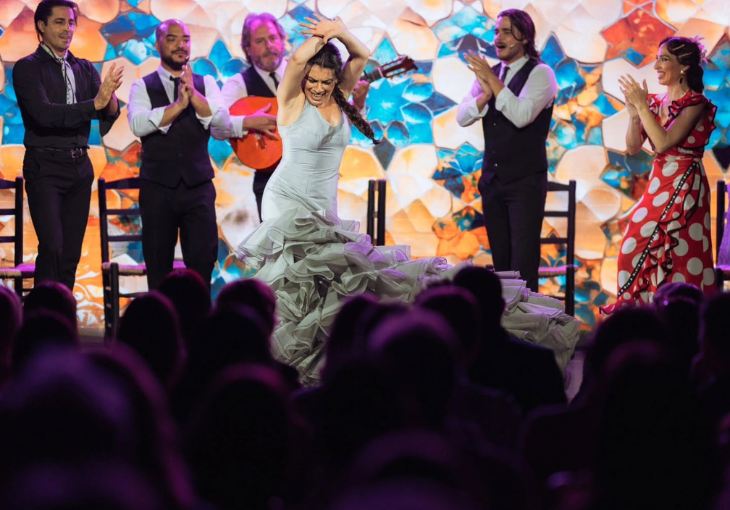
This family takes on another dimension when dance becomes part of the performance. Its rhythm provides a framework for marking steps, calls, closing flourishes and footwork, always in dialogue with the guitar and singing.
In live flamenco, dance never exists in isolation. The singer watches and listens to the dancer; the guitar accompanies and responds; the dancer interprets the singing and plays with the rhythm. Each element influences the others.
Learning to recognise flamenco’s different families
Soleá, seguiriya, tangos, bulerías, fandangos, cantiñas… Learning to recognise flamenco’s different styles and families offers a new perspective on the art.
You do not need to understand their structures beforehand to be moved by a performance. But gradually discovering their conventions helps you notice details you might otherwise miss: a change in the singing, a cue from the dancer, a response from the guitar or a particular way of marking the rhythm.
Cantiñas are an excellent example of this richness. Under one shared name, we find different styles that retain their musical connections while each possessing an identity of their own.
Discover flamenco styles at Teatro Flamenco Barcelona
At Teatro Flamenco Barcelona, every performance offers a chance to explore this diversity through the interplay of singing, dance and guitar.
On stage, these styles become a live experience. You hear the rhythm, but you also feel it in the movement, the handclaps, the guitar playing and the way the artists respond to one another.
Book your tickets for Teatro Flamenco Barcelona and experience the power of live flamenco up close.